Get flexible financing and instant approvals for urgent home repairs—apply online today.

Tag: electrical inspection

Electrical Inspections in Lake Havasu City, AZ

Spotting and Preventing Electrical Hazards at Home

Electrical hazards in your Lake Havasu City, AZ home can result in fires, damage to devices and electronics, and electrocution. Recognizing electrical hazards can help you prevent problems and promote a safer home environment. We here at Air Control Home Services can assist by performing a routine electrical inspection once per year and taking care of necessary repairs or maintenance.

Finding Electrical Cord Damage

You should periodically inspect all the electrical cords in your home for signs of damage, such as fraying, exposed wires or cracks. Look for dark marks on your cords that could indicate overheating or burning. Damage to these cords can put you at risk of electrocution if you touch exposed wires. This can also lead to a house fire if sparks come from the cords and ignite items nearby. Throw away any items that have damage.

Circuit Overloading and Overheating

When you plug too many electronics or devices into one outlet, this can lead to circuit overloading. This causes wires and devices to overheat, increasing the risk of an electrical fire. This can also cause permanent damage to your items. You may experience circuit breakers tripping frequently if this is an issue.

Problems With Your Wiring

Electrical wiring can last anywhere from 50 to 70 years. Over time, wiring can experience wear and tear from normal use, leading to problems and loose connections. However, incorrect installation can also cause damage, even in a brand-new home.

For partial replacements or whole-home rewiring, we always recommend that you work with an experienced and knowledgeable professional, such as the technicians on our team at Air Control Home Services. We complete all work according to local code to ensure safety and electrical integrity. Not only will this prevent dangerous situations, but it can also prevent inconvenient electrical failures.

Combining Water With Electricity

Water is an excellent conductor of electricity. When you combine these two things, electricity can travel through the water and cause electrical shock, fire or short circuits. If you have electrical appliances near a water source in your home, this is a dangerous pairing. Outlets that are near water should be ground fault circuit interrupters, or GFCIs for short.

These outlets protect against electrical shock by turning off power when they sense an imbalance in electrical current. You’ll commonly find them in kitchens, bathrooms and outside. Consider the placement of your outlets and the devices you have plugged in near water sources.

Outlets and Switches That Feel Warm

Touching the faceplate on your switches and outlets will alert you to anything that feels warm to the touch. This can indicate that there is a problem with your wiring that’s causing overheating. The only exception is a dimmer switch. They have the potential to feel slightly warm. However, they shouldn’t feel overly hot.

In addition to outlets that feel warm, make sure you never experience any degree of electrical shock when you touch these fixtures. Faulty wiring, grounding issues and overloaded circuits are common causes of shock.

Experiencing Frequent Appliance and Device Problems

Do you find yourself frequently calling for repairs for the same appliances or devices in your home? Electrical issues could be to blame. The same applies if you’re replacing appliances more frequently than is typical and there are no other known issues, like water quality concerns.

Smoke or Burning Smells

You should never see smoke coming from any of your outlets or switches. Smoke indicates serious damage in the wiring behind the walls. If you do see smoke or burn marks around an outlet, cut power to that circuit immediately and call for assistance. This also applies if you smell something burning inside your walls, outlets or switches.

Increases in Energy Consumption

Are your monthly energy bills increasing even though your usage isn’t increasing? Electrical issues could be to blame. These kinds of increases could develop slowly over time, or they could be more sudden. You may be experiencing energy loss, which is causing your electrical system to work harder to power your lights, appliances and more. Overloaded circuits and short circuits can also raise energy consumption.

Lights That Flicker or Dim

If you notice your lights flickering or dimming randomly, you may have an overloaded circuit. This may occur intermittently or when an appliance or device turns on in your home and it is on the same circuit as the lights that are affected. Loose wiring is another common cause of the problem.

Buzzing or Humming Sounds

Your electrical system should be completely quiet. If you notice buzzing or humming sounds coming from areas with wiring, you might have issues with loose connections, damaged wiring, faulty breakers or overloaded circuits. Transformers buzz or hum normally, but this shouldn’t be an issue you notice in your home. Electrical panels may buzz or hum as they age and develop issues, such as aging components or damage. An upgrade can resolve this problem and keep your household safe.

Incorrect Use of Extension Cords

Extension cords can be a convenient solution when you need electrical access somewhere in your home or property that does not have a nearby outlet. However, many homeowners use these cords as a permanent solution, which can lead to an increased risk of fire or electrocution.

If you must use an extension cord, inspect it for signs of damage. Replace any cords that are damaged or very old. Always use a cord that is rated for the area where you are going to place it. For example, outdoor cords versus indoor ones. Keep your cords away from areas where they pose a tripping hazard or could become submerged in water.

Purchase a cord that is UL-rated. Underwriter’s Laboratories is a global safety organization that tests and certifies electrical products to ensure safety standards. Buying a UL-rated item will provide you with peace of mind and reliability for many years.

The Use of Surge Protectors

A surge protector contains metal oxide varistors, which absorb excess voltage. Surges are redirected to the ground to help stabilize the voltage. Make sure that you’re using surge protectors throughout your homes for things like televisions, computers and charging stations.

Different types of surge protectors are available. Power strip surge protectors are common for residential use. They provide you with more usable outlets while ensuring ample protection against power surges. A whole-house surge protector is installed on your electrical panel and protects your entire house. There are also uninterruptible power supply surge protectors, which offer battery backup and surge protection together.

We here at Air Control Home Services encourage you to educate your family members on safe electrical practices. This will help minimize the risk of hazards and keep you safe. Our electrical service team can help with annual inspections, update your outdated wiring, and make emergency repairs. We stay up to date on modern safety standards and local code enforcement.

Reach out to our team at Air Control Home Services in Lake Havasu City for more information or to schedule an appointment today.

Electrical inspection in Lake Havasu City, AZ

10 Warning Signs Your Home Is at Risk for an Electrical Fire

Electrical fires are serious and destructive hazards that impact thousands of homeowners each year. According to the Electrical Safety Foundation (ESF), approximately 51,000 electrical fires occur in America every year. These fires result in nearly 500 deaths and $1.3 billion in annual losses from property damage. In fact, the ESF reports that residential electrical distribution systems are the third-leading known cause of home structural fires. While most people understand that fires can start due to a spark or flame reacting to ignition, many homeowners are unaware of the possible sources of electrical fire located throughout the house. A look at the top 10 ways an electrical fire may start can help you take important steps to protect yourself and your loved ones.

1. Arc Faults

Arc faults occur when a high-powered electrical current flows through an unplanned path between two or more conductors. When a powerful discharge of electricity leaps between these conductors, the electrical current creates an “arc” or bowed shape along with sparks that may start a fire. According to the ESF, arc faults cause over 28,000 home fires in the United States per year. Arc faults can result from damaged wiring, frayed cords, or loose connections that inadvertently enable electricity to escape an intended path and take another course instead. Unfortunately, arcing faults can generate flash heat of up to 1,000°F and create a fire. To prevent arc faults, ask your electrician about installing arc fault circuit interrupters (AFCIs). An AFCI is a type of circuit breaker that detects and disrupts the flow of an electrical arc before it causes significant damage.

2. Short Circuits

Short circuits occur when an electrical current travels along an unintended path between two nodes with little to no resistance. As the name implies, short circuits travel a very short distance and can result in an excessive current flowing in a very limited amount of space. Short circuits can result in house fires, electrocution, or device failure. Unfortunately, common household activities can increase the risk of short circuits without anyone realizing it.

For instance, wires pinched from doors, windows, or furniture can disrupt the flow of electricity and create a short circuit. Instead of flowing down an intended path, the electrical current in the wire will simply travel to the nearest node. Similarly, a nail or screw that punctures an electrical cord in the wall can also disrupt electrical flow. Sings of a short circuit include breaker trips, blown fuses, or electrical appliances that suddenly shut down. Evidence of a previous short circuit may include charred light switches or burning smells. Reach out to an electrician if you notice any of these signs.

3. Faulty Electrical Outlets or Appliances

Faulty or aging outlets and appliances are more likely to have worn-down or defective cords, receptacles, switches, or plugs. These damaged parts can draw an excessive amount of power and generate dangerous levels of heat. The combination of wayward electrical current, high heat levels, and potential fuel from melting appliances can all cause a home fire. Experts recommend regular inspections of electrical outlets and routine maintenance of major appliances using the manufacturer’s instructions.

4. Overloaded Light Fixtures

Light fixtures represent another source of electrical fires. Every fixture or lamp in your house corresponds to lightbulbs with designated amounts of wattage. This denotes how much electrical current the lightbulb may safely draw and how much power it should supply. It’s important to always use the correct wattage when changing lightbulbs. For example, if your lamp requires a 40-watt lightbulb, resist the urge to replace it with a 70-watt bulb. When a bulb attempts to draw a higher current than the socket can supply, too much electricity can surge into an insufficient wire. This phenomenon is called “overlamping,” and it can generate excess heat and start an electrical fire. Never overload your fixtures in this way. If you need more powerful lighting, ask your electrician about installing LEDs that use less wattage but produce brighter light. LEDs also generate less heat than conventional incandescent bulbs.

5. Flammable Materials

Flammable materials near hot light fixtures or heaters can start an electrical fire. According to the U.S. Fire Administration (USFA), most electrical fires start in the bedroom even if the greatest number of fatalities occur in the living room or den. The bedroom is full of flammable materials like paper, bedding, curtains, clothing, or drapes. Keep these items far away from lampshades and other electric heating sources.

6. Extension Cords

Extension cord misuse is a top cause of electrical fires. Never use extension cords for large household appliances. If you do not have nearby outlets for major appliances, contact an electrician to install one for each unit. It’s also important to use extension cords with the correct amperage. If you attach an extension cord to a device that draws more amps than the cord can manage, the cord can easily overheat and spark a fire. For example, experts advise against attaching extension cords to power-drawing appliances like microwaves. Manufacturers also design indoor and outdoor extension cords differently. Outdoor cords often have ground fault circuit interrupters (GFCIs) for protection against accidental exposure to moisture or water. For this reason, you should never use an indoor cord on the outside of your home.

7. Portable Space Heaters

According to the USFA, space heaters are among the most common causes of fatal electric fires in the home. The space heaters that pose the greatest risk have super-heated coils on the surface. These coils can instantly ignite combustible materials like carpet or upholstery. If possible, avoid coil models and use liquid-filled “soft heat” space heaters instead. You should also look for a space heater with an automatic shut-off feature or overheat protection. The National Fire Protection Association (NFPA) recommends keeping your space heater at least three feet away from any flammable material and unplugging the device when it’s not in use. Never use a space heater with an extension cord.

8. Outdated Wiring

Old or outdated wiring can cause widespread house fires. If your home is more than 20 years old, reach out to an electrician to assess the condition of your wiring. For example, an older home may have deteriorated aluminum wires that your electrician may need to replace or upgrade with copper wiring. According to the Consumer Product Safety Commission (CPSC), houses with outdated aluminum wiring are 55 times more likely to have fire hazards than buildings with a copper wiring system. Signs of electrical wiring problems can include breaker box issues, flickering lights, or unexplained power outages. You may also notice that appliances feel overheated to the touch or smell burning odors in the home.

9. Ungrounded Plugs

Some appliances have three-pronged cords to ensure sufficient wattage and current flow. You should always use these appliances with a grounded outlet. This type of outlet has a third hole to create an additional path for stray electricity and helps prevent electrical figures. If your house is full of ungrounded plugs, reach out to an electrician to upgrade these outlets. Although it may feel tempting to circumvent this process using power strips and extension cords, doing so can quickly start an electrical fire.

10. Poor Modifications

Improper modifications or renovations can also cause electrical fires. For example, improper replacement of a breaker box can result in an overflow of electrical current that endangers your home. Trying to pick your own wiring that does not match the circuit amperage can also cause a fire. In addition, your local government may impose fines or other consequences if you alter an electrical system in a way that is not up to code. Insurance companies may also find you liable and deny any damage claims. It’s best to hire an electrician before any major home project.

Contact Us Today

While electricity has improved our lives for the better, electrical problems constitute major safety hazards. Fortunately, the experts are here to help. Air Control Home Services provides home electrical services in Lake Havasu City, Mohave County, and the surrounding areas. We offer electrical installations and routine electrical panel inspections. Our licensed electricians can upgrade your lighting or rewire the entire home. We also offer whole-home surge protection and EV charger installation. No matter the issue, we can help. Contact Air Control Home Services today for all of your electrical needs.

Electrical services in Lake Havasu City, AZ

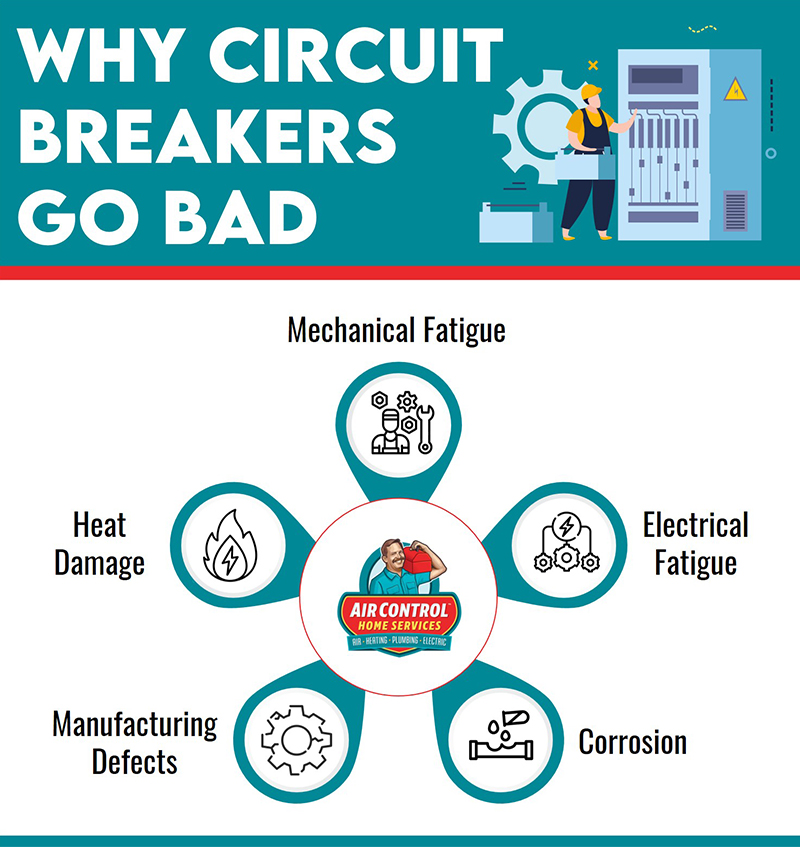
Can Electrical Breakers Go Bad?

Electrical circuit breakers serve as the first line of defense in protecting your home from a possible incident. Typical electrical breakers will do their job without a problem for years or even decades. When they stop working properly, it can lead to many functional issues and several potential safety risks. Here is a look at how electrical breakers may fail and what the associated signs of failure tend to be from the electrical team at Air Control Home Services.

Contact Us

Mechanical Fatigue

A breaker is effectively a switch, and it operates mechanically, just like any other on-off switch. The components tend to be stiffer, though. Consequently, the influence of mechanical fatigue makes weakening more obvious than it might be with a normal switch. Friction can also wear the metal down. Likewise, banging or even constant vibrations can loosen soldered components.

Wear and tear causes the metal components inside the breaker to lose their springiness. Over time, this can cause the metal to move farther from closing the circuit. More worrisome, the electricity will still try to jump the gap for a while. Consequently, the circuit breaker may operate in an unsafe condition because the electricity is arcing.

There are several signs of mechanical fatigue in a circuit breaker. First, it might not trip as quickly as it should. Second, it could trip intermittently or only when under extremely high loads. Third, there may be an electrical sound near the box because of the electricity arcing. Fourth, the breaker could trip faster and more often than it should. Finally, extreme wear could cause the circuit to break permanently to the point where you wouldn’t be able to reset it manually.

Electrical Fatigue

People tend to think of electricity as this ephemeral thing that just comes and goes without doing much other than turning lights on. However, electricity stresses everything that its current runs through, and it can slowly break down the insulation inside the circuit breaker. It also can erode the metal surface, reducing the quality of the contact and encouraging arcing. An excessive load could also weld the circuit. Electricity can even slowly change the characteristics of the metal, amplifying or reducing resistance and conductivity.

Depending on the nature of the electrical fatigue, the breaker might fail to break or simply trip and then quit working. Electrical fatigue also can cause the breaker to perform poorly, potentially tripping at lower or higher loads than expected.

High-usage circuits are more likely to have breakers that experience electrical fatigue. If someone runs devices that aren’t right for the power specifications on the circuit, this will speed up the process. For example, a high-capacity freezer operating out of spec for the circuit will drive fatigue.

why circuit go bad

Corrosion

Electrical circuit breakers sit inside panels that are often in locations like basements and service closets. This keeps them out of the way, but they also sit in places where the air usually doesn’t circulate well. Humidity can cause moisture to collect inside the circuit breakers. Over time, the moisture will react with the breakers’ metallic elements.

Notably, the presence of electricity doesn’t help. Electricity often encourages oxidation because it speeds up reactions between chemicals in the humid air and the metals in the breakers. Also, corrosion can cause the breakers to arc, leading to a feedback loop where more reactivity drives more corrosion.

Corroded breakers cause numerous problems. If you use equipment that’s sensitive to signal stability in the line, those devices may not work as well. For example, it could take longer than usual to charge your phone because it’s not getting stable electrical current.

As conductivity breaks down in the circuit, it may trip because of a false positive. Essentially, the breaker detects that something is wrong with the current and flips. This is just because the corrosion is messing with the circuit, but the breaker isn’t advanced enough to handle that scenario.

In extreme cases, you may see visible signs of corrosion. Dirty or rusty materials may collect in the circuit, inside the panel, or below the box.

Unsurprisingly, anything that drives humidity makes corrosion worse. Flooding is always bad, even if you can dry the area out quickly. You should always ask one of our electricians to check the breakers after any flooding has occurred.

Manufacturing Defects

Not every circuit breaker that comes off the factory line is in good enough condition to do the job. Quality control in the industry is excellent, but the process isn’t perfect. Companies sometimes mislabel breakers, leading to installations with the wrong capacities or fittings. Also, internal elements like solder points can suffer damage during the shipping or installation process.

The worst sign of a manufacturing defect in an electrical circuit breaker is a noticeable smell. It may be a detectable smell of ozone if there’s arcing. However, extremely defective breakers that don’t trip can overload. The result is melting plastic in the breaker’s housing, and you can smell smoke as the plastic melts. In the worst-case scenario, the plastic could catch fire.

Another sign of a manufacturing defect is that the breaker fails under normal load far sooner than you’d expect based on the manufacturer’s indications. Alternatively, the breaker might not trip at all, especially if it’s a mislabeled high-capacity breaker. The breaker also might not fit tightly in the socket if some components are loose. In extreme cases, there could be a noticeable gap around the breaker in the socket.

Heat Damage

Over the lifetime of any electrical circuit breaker, a lot of heat will transfer through its components. This is normal, but it also will affect the breaker’s performance with age. Particularly, thermal trip elements inside the breaker will slowly stop performing at their expected breaking points. Especially if a circuit breaker has exceeded its mechanical life expectancy, you may notice this problem. You can test for it from a distance by pointing a thermal imager at the panel. If you see a warm spot around one breaker or a cluster of breakers, then there’s a good chance that heat is causing some problems.

Heat damage generally causes electrical resistance to increase in a circuit breaker. Higher resistance can trip the thermal element faster. However, a total failure of the breaker might result in it not detecting an overload at all, just allowing the current to flow through no matter what.

You may also notice voltage drops that can affect the performance of your household devices. The issue is most common in power tools, but some sensitive electronics may refuse to work if the voltage is too far out of spec.

Note that not all heat damage is age-related. If there is a manufacturing defect, there might be excess heat coming from a circuit breaker early in its anticipated lifespan.

Call Air Control Home Services

Our team at Air Control Home Services performs a host of electrical services for residents of Lake Havasu City, AZ and the surrounding area, including work on electrical panels, wiring, lighting, EV chargers, and whole-house surge protection.

If you’re concerned about the electrical breakers in your home, call us right away at Air Control Home Services, so we can send an electrician to find out what’s happening.

Everything You Need to Know About Electrical Panels

Everything You Need to Know About Electrical Panels

Updated: January 26, 2025

At the heart of every house’s electrical system lies one or more electrical panels, which control circuit loads, distribute electricity, and ensure safety. Any Lake Havasu City homeowner or electrician working on a residential property would do well to familiarize himself with the many varieties of electrical panels, as well as their functions, applications, installation procedures, and maintenance needs.

The team at Air Control Home Services explains everything you need to know about your electrical panel. Read on to find out more, or reach out to us with any questions you have!

Contact Us

Main Breaker Panel

The main breaker panel is where you’ll find the circuit breakers that regulate the flow of electricity to different rooms in your house. It serves as the main hub for the home’s electrical distribution, controlling everything from outlets to appliances. In an emergency or repair, this panel’s primary circuit breaker can cut electricity to the entire house, making it an essential safety element.

Where the main power line enters the house is usually where you’ll find the primary breaker panel. This central location guarantees effective distribution of electricity to all locations. Securing the panel to a wall, typically in a basement, garage, or utility room, is the first step in the installation procedure. The electrician will next attach the incoming power line to the main breaker and, one by one, install circuit breakers on the circuits that need power.

Main Lug Panel

Main lug panels differ from main breaker panels because they lack main circuit breakers. Instead, they rely on an independent disconnect switch, typically located outside the panel or in a separate area of the house. If a building or residence has more circuits than the main breaker panel can handle, a backup panel is usually necessary.

Installing the panel requires running heavy-gauge wires from the panel to the main breaker panel or an alternate power source. To avoid electrical risks, electricians must ground the panel and check that all connections are tight.

Subpanel

To direct electricity to individual rooms or circuits in a house, an electrician may install a subpanel, which is an additional electrical panel that connects to the main breaker panel. An electrical feeder wire extends from the main breaker panel to the subpanel, allowing electricity to flow between the two. Installing a subpanel is a common practice in larger homes or places with high power demands, like home offices or workshops, when the main breaker panel can’t manage all the electrical loads.

Step one in installing a subpanel is finding a good spot to attach it and then running the feeder cable and connecting it to the main panel’s double-pole breaker. After that, the electricians will distribute power to the specified circuits by attaching individual circuit breakers to the subpanel.

Don’t miss out on our latest deals! Check out our specials and save big on your next service.

Transfer Switch

Houses that use backup generators must have a transfer switch. In the event of a power outage, it allows for a smooth transition from utility power to generator power. Automatic and manual transfer switches are both available. In contrast to an automatic transfer switch, which detects power outages and automatically switches to generator power, a manual transfer switch requires the homeowner to turn on the power source.

Connecting the transfer switch to the generator and main breaker panel is an important part of the installation process. To avoid electrical risks, electricians must keep all connections tight and ground the switch correctly. In fully automated systems, the transfer switch gets hardwired into the generator’s control panel.

Fuse Box

As an alternative to modern circuit breakers, the older style of electrical panel known as the fuse box protects electrical circuits using fuses. When a fuse detects an overload, it will blow to cut power to the circuit, protecting it from potential harm or fire. Fuse boxes are more common in older buildings and homes, but they are also present in some newer ones.

Assembling a fuse box requires fastening it to a wall and linking the primary fuse to the incoming electricity line. After that, electricians will connect individual fuses to the circuits that need power. To ensure adequate protection, the amperage rating of each fuse should correspond to the electrical load of the linked circuit.

Smart Panel

Modern electrical panels with built-in sensors and other smart technologies can track and control your energy consumption in real-time like never before. In addition to allowing for remote control and monitoring, smart panels can connect to home automation systems.

Connecting the incoming power line to the main breaker and firmly attaching the smart panel to a wall are the two basic steps in installing one. The next step is for the electricians to link the smart panel to the home’s Wi-Fi network and attach individual circuit breakers. To connect the smart panel to other smart home gadgets, they might need to run extra wires.

Maintenance Requirements for Different Types of Electrical Panels

To keep your home’s electrical system safe, reliable, and efficient, it is vital to maintain the electrical panels. Different types of panels necessitate different maintenance methods.

You can start by inspecting the main breaker panel regularly for signs of corrosion, damage, and secure connections. To make sure it trips properly when an overload occurs, test the main circuit breaker regularly. To avoid electrical problems and overheating, you must keep the panel clean and dust-free.

Also, check the main lug panels regularly to make sure there is no obvious damage and that all connections are tight. Because there is no main breaker on these panels, you must ensure the separate disconnect switch is in good working order. To keep overload protection in place, you’ll need to inspect individual circuit breakers regularly.

Inspecting subpanels is necessary for checking connections and grounding. Look for frayed wires or faulty connections. An expert can perform overload tests on the subpanel circuit breakers to ensure they will protect the system properly.

Regular testing is also required to ensure that transfer switches, whether manual or automatic, work properly in the event of a power loss. Grounding and connection inspections are of the utmost importance for their safe operation. Automatic transfer switches may also require software upgrades and testing under simulated power loss scenarios.

Even though they aren’t as popular, fuse boxes still require routine inspection to make sure the fuses are appropriate for the circuits they protect. Important things to remember include checking for adequate grounding and replacing blown fuses quickly. Preventing overheating and fire concerns requires keeping the box clean.

Smart panels necessitate regular software and physical inspections. Checking the connections and breakers regularly is key to their safe operation. Updating the panel’s software also ensures it will work with new features and devices, which improves its capacity to monitor and manage energy. Dust accumulation can lead to overheating; wipe the panel regularly to avoid this.

Anything to do with electricity can be dangerous, and it is a safe bet to let professionals handle your electrical panel services!

Air Control Home Services is here to meet all of your electrical maintenance needs. We also help homeowners in Lake Havasu City, AZ with HVAC installations, ductless AC repairs, duct sealing, drain cleaning, and much more. Call us today to schedule an electrical installation or inspection for your home.

Air Control Home Services

Book Online

Book your service in less than a minute.