Get flexible financing and instant approvals for urgent home repairs—apply online today.

AC repair in Lake Havasu City, AZ

How to Stay Cool While Waiting for AC Repairs in the Summer

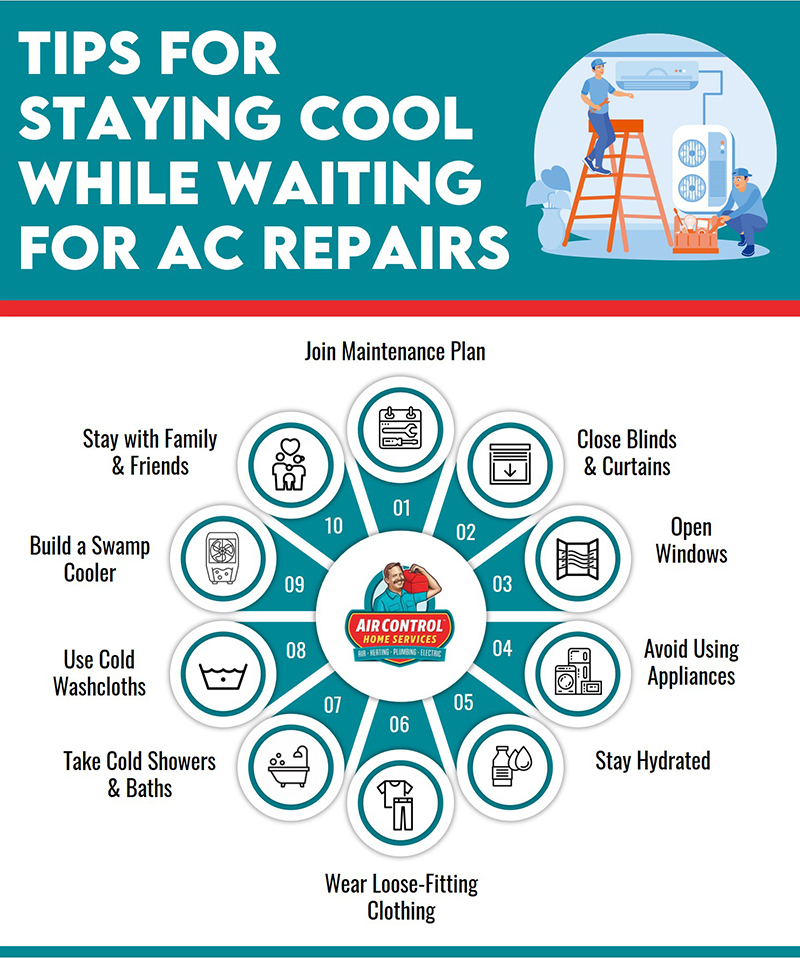
Here in Lake Havasu City, AZ, we experience several months each year with temperatures in the triple digits. Trying to survive without air conditioning can be hazardous to your health at those temperatures. However, air conditioners, like all machines, can break down. When that happens, you’ll need to find ways to stay cool while you wait for repairs. Here are 10 tips for staying cool while you wait for our HVAC team from Air Control Home Services to arrive.

Contact Us

1. Shorten Your Repair Wait Time

Anything you can do to reduce your AC’s downtime is a good idea. You should consider enrolling in our maintenance plan as soon as possible. This plan comes with priority service, no overtime fees, and access to a dedicated concierge line. Being a member means you skip to the head of the line when your AC needs repair. There won’t be a need to depend on alternate means of keeping cool longer than necessary.

2. Keep the Sun Out

Closing your home’s blinds and curtains is essential to control the temperature inside your home during the summer months. While you wait for AC repairs, you should close them before sunrise and leave them closed until sunset. If you have medium-colored curtains with white plastic backing, they can cut solar heat gain by up to 33%. When you’re stuck with no air conditioning, that’s a significant improvement.

3. Remove Heat at Night

Keeping heat out of your home during the day will help keep you cool, but expelling heat at night can also be beneficial. Open your windows to maximize ventilation when the sun goes down. Use large fans to push hot air out of your open windows overnight. If you have a multi-story home, set your exhaust fans up on the second floor. Since heat rises, you’ll exhaust more heat while drawing cooler air in through your first-floor windows.

4. Avoid Using Major Appliances

Using your home’s major appliances will significantly increase the temperature inside your home. When you’re without AC, refrain from cooking for long periods of time using your oven. Doing laundry and running your dryer can also produce heat and should be avoided. This will minimize unnecessary heat gains and help your other cooling strategies work more effectively.

5. Stay Hydrated
tips stay cool

Fortunately, our bodies have a built-in cooling mechanism that works exceptionally well. However, you need to stay hydrated if you want to support this process. When we sweat, the moisture evaporates off our skin, carrying heat with it. In dry climates like ours, the air readily absorbs your skin’s moisture, accelerating the cooling process. In extreme heat, your body can lose up to 1.5 liters of water per hour as sweat. Keep plenty of cold water on hand to rehydrate.

6. Wear Loose-Fitting Clothing

To maximize the benefit of sweating, you must keep air flowing across as much of your skin as possible. The best way to accomplish that is to wear light, loose-fitting clothing. Not only will this allow air to circulate underneath your clothes, but it will also prevent your clothing from absorbing your sweat and becoming damp. When that happens, the heat in your sweat stays trapped against your body, negating the cooling effects.

7. Take Cold Showers and Baths

Even on hot summer days, your home’s tap water should be significantly cooler than the air temperature. You can take advantage of that by taking cold showers and baths. Even if your home’s tap water is lukewarm, it should still help you cool off.

8. Use Cold Washcloths

You can also strategically use cold washcloths to stay cool while you await AC repairs. The best way to do this is to dampen as many washcloths as possible and store them in your refrigerator or freezer for a short period of time. Then, apply them to your pulse points on your neck and wrists. This will keep you cool and slow your pulse, preventing you from overheating. When your washcloths get warm, swap them with a fresh set from the refrigerator or freezer.

9. Build a Makeshift Swamp Cooler

If you expect to be without AC for more than a day or two, you could build a swamp cooler to stay cool. A swamp cooler uses evaporation to produce cool air. A small DIY version can cool the air in a small room by between 15 and 40 degrees Fahrenheit. Best of all, they’re most effective in dry climates like ours.

To build a swamp cooler, you’ll need a few items. The first is a five-gallon foam cooler. It will house the rest of the components and provide an insulated space inside. Plus, foam is easy to cut, making assembly easier. You will also need a desk fan and three, 6-inch lengths of 3-inch-diameter PVC pipe.

To assemble the cooler, cut a hole in the foam lid that’s large enough to allow the fan’s face to fit. Then, cut three equidistant 3-inch holes about 2 inches from the top edge on one of the cooler’s sides. Next, insert the PVC pipes into the three holes.

To use your swamp cooler, fill the bottom of the foam container with either cold water or ice. Then, put the lid on and place the fan in its hole. When you turn the fan on, it will push warm air straight down onto the ice. That will cause the ice to melt, evaporating its water and cooling the air in the process. The cold air then gets forced out of the three PVC tubes to cool the area around the container.

10. Arrange a Short Stay With Family or Friends

If you’re older or otherwise especially vulnerable to heat, you shouldn’t try to wait for AC repairs in your home. Instead, you should arrange to stay at a friend’s or family member’s home. Only air conditioning can keep your home sufficiently cool during the Lake Havasu City summer. While the foregoing tips might make the heat bearable, you could still suffer ill effects.

If there’s nobody nearby you can stay with, consider spending as many daylight hours as possible outside the home. Stores and malls are usually air-conditioned, and you can get through the hottest parts of the day that way. Then, you can return home at night when fans alone will keep your home at a reasonable temperature. Remember to close all your home’s blinds and curtains while you’re out.

Local Rapid AC Repair Specialists

The bottom line is that prompt AC repairs are the best way to beat the heat when your AC breaks down. Air Control Home Services is the HVAC company to depend on. We offer expert HVAC installation, repair, and maintenance. We’re a Trane Comfort Specialist and a Mitsubishi Electric Ductless Elite Pro. We’re also Better Business Bureau accredited with an A+ rating. If you need the AC in your Lake Havasu City home repaired, contact our team at Air Control Home Services today!

frozen drain

How to Fix a Clogged AC Drain Line

The AC drain line prevents water damage by channeling condensation away from your Lake Havasu City home. This small but vital pipe collects water from the air conditioner’s drain pan and expels it outside, helping to maintain a comfortable and moisture-free environment inside your house.

However, a clogged condensate drain can compromise this system, increasing humidity inside your home and potentially causing mold growth on your walls. Recognizing the signs of a clogged AC drain line is the first step towards timely intervention, scheduling air conditioner service saving you from expensive water damage repairs.

In this guide, we will cover:
  • Signs of a Clogged AC Drain Line
  • Step-by-Step Guide to Fixing a Clogged AC Drain Line
  • Preventing Future Clogs

Understanding and addressing these issues promptly can help ensure your system continues functioning efficiently and protects your home from moisture-related problems.

Looking for a trusted pro to get your AC unit up and running again?

At Air Control Home Services, we’re proud to be the preferred HVAC company of countless Lake Havasu homeowners. With more than 30 years of experience and thousands of 5-star reviews under our belt, we come to your home fully equipped to perform any HVAC service, from air conditioner repair to air conditioner maintenance.

Schedule AC service

Signs of a Clogged AC Drain Line

You must first recognize several telltale signs to determine if your AC drain line is clogged. Often, a condensate drain becomes clogged when you neglect routine maintenance. During a regular AC tune-up, a technician will thoroughly inspect your drain line and remove any built-up debris. If you don’t call for regular maintenance, however, the pipe will become severely backed up.

ac drain line indoor
Here are some common signs that you have a clogged AC drain line:
  • Standing water near the indoor unit
  • Musty smell coming from vents
  • The inability of the AC unit to turn on or shut down
  • Water damage in areas near indoor unit
  • Lack of cool air coming out of vents

Step-by-Step Guide to Fixing a Clogged AC Drain Line

Want to know how to clear a clogged AC drain line?

This tried-and-true process can help you get your unit up and running again:
    • Turn off the unit:

For your own safety, turn off your air conditioner before working on it. Even if the unit isn’t actively running, power it off just to be safe.

    • Locate the drain pan:

Locate the drain pan underneath the evaporator coils in the indoor unit. If there’s standing water inside the pan, use a rag or wet vac to remove the moisture and prevent mold growth.

    • Unclog the condensate drain line:

If most of the debris is visible, put on gloves and remove as much as possible by hand. Next, pour one cup of liquid bleach or distilled white vinegar down the pipe to flush it out. Let the solution sit for 30 minutes before flushing it out with water. If this doesn’t clear the clog, we recommend using a wet/dry vacuum to get to the root of the problem.

Preventing Future Clogs

Now that you’ve unclogged your AC drain line, you’re probably ready to move on with your day. However, it’s important to determine what led to the clog in the first place. Doing so will help ensure you’re more careful about preventing the same issue from happening in the future.

To prevent your AC drain line from clogging again, be sure to schedule regular maintenance. During a routine tune-up, an HVAC technician will examine each part of your system and clean it thoroughly. Routine inspections and cleanings prevent water and debris accumulation inside your unit, which can cause mold growth and other issues.

Boost the performance of your AC system with top-tier service.

Whether you’re looking to schedule air conditioner maintenance or an air conditioner repair, the seasoned experts at Air Control Home Services are here to help. We’ve treated our customers like family since 1990, and our 100% satisfaction guarantee illustrates our commitment to improving homeowners’ lives.

Schedule AC service

What’s the Cost of an Air Conditioner Repair in Lake Havasu City?

The last thing anyone wants is for their AC unit to break down when the temperature is climbing into the triple digits. But let’s face it: AC units are machines, and machines can fail, often at the most inconvenient times. Given that scenario, one of the first questions that pop into your mind is likely the cost of fixing it.

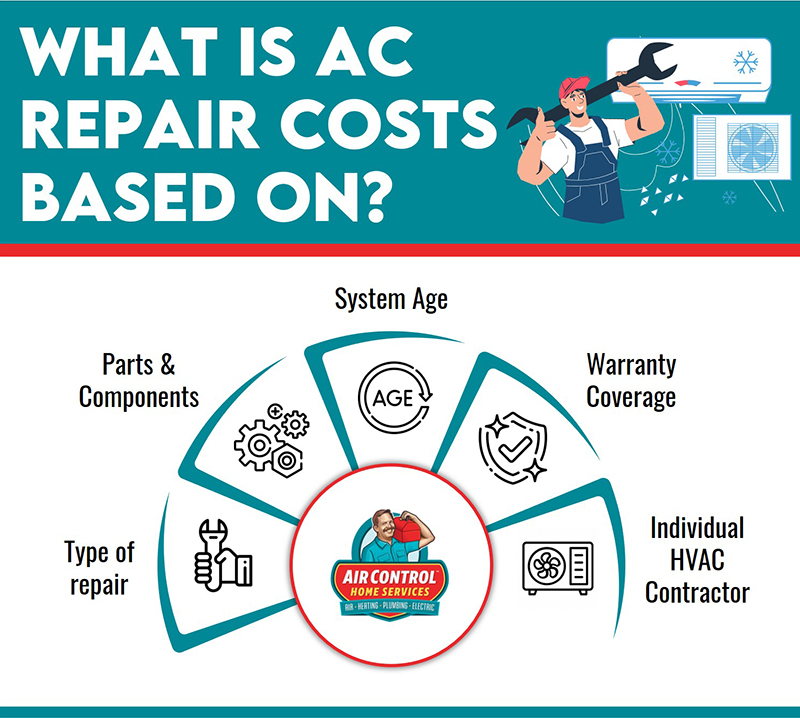
Most homeowners first ask when scheduling repairs, ​“How much will it cost?” The AC repair cost in Lake Havasu City can range from $100 to $1,000+, averaging around $500. The exact cost is based on the following factors:

  • Type of repair
  • Parts & components
  • System age
  • Warranty coverage
  • The contractor you hire

In this blog, the HVAC team at Air Control Home Services will examine these factors in more detail, giving you a better idea of how much your Lake Havasu AC repair cost may be.

Contact Us

Type of Repair

The first factor to consider when it comes to the AC repair cost in Lake Havasu is the repair type. As you can probably guess, complex repairs are more expensive than simple ones. For example, locating and resolving a refrigerant leak is much more time-consuming and labor-intensive than swapping out air filters.

It’s important to note that repairs can become more complicated depending on the accessibility of your air conditioner. For instance, say your AC unit has a ventilation problem. If the unit is easily accessible, the technician should be able to clear debris relatively easily. However, if it’s in a small attic or crawlspace, the repair will be more difficult to execute, leading to higher costs.

cost to repair ac

Parts & Components

During a repair, the HVAC technician may determine that you need a replacement part. The cost of this part — as well as the amount of effort it takes to install it — will influence your overall costs. Here are some parts that are typically expensive to replace:

  • Compressors
  • Fan motors
  • Condensers
  • Evaporator coils

While some of these parts can be repaired, others will almost always need a replacement. Evaporator coils, for instance, usually cannot be fixed with a repair.

System Age

It’s a good idea to consider the AC system’s age during a repair. With regular maintenance, most air conditioners last for about 15 years. If your air conditioner is over 10 years old and experiencing problems, it’s usually better to replace it. Although a new AC installation will have high upfront costs, it will save money on energy and repair expenses down the line.

Are you unsure whether it’s better to get a replacement? Our team can help. After carefully evaluating your system, we’ll let you know which option is best for both your cooling needs and budget.

Warranty Coverage

A major factor that impacts the air conditioning repair cost in Lake Havasu is your warranty coverage. There are two main warranties to consider:

  • Parts Warranty
  • Labor Warranty

The first is your parts warranty, designed to protect you from manufacturer errors. If a part within your AC unit stops working, the manufacturer may be responsible for the replacement cost (provided you have received regular AC maintenance). In general, parts warranties last between five and 10 years. Your AC manufacturer can give you more information about your warranty.

The second one is your labor warranty. As the name suggests, this covers the labor cost during the repair. Most labor warranties are valid for one or two years. If you’re unsure whether your labor warranty is valid, contact the company that performed the installation.

The Contractor You Hire

Lastly, the contractor you hire can affect your overall repair costs. If you go with the lowest price, you may end up with low-quality work. Of course, you don’t want to overspend either.

Air Control Home Services is committed to delivering 5‑star service at a fair, honest price. With every project, we promise a 100% satisfaction guarantee. Our ultimate goal is to ensure every customer is happy with the service and total cost.

Air Control Home Services

Book Online

Book your service in less than a minute.